Breaking Down the Back Walkover
April 23, 2025

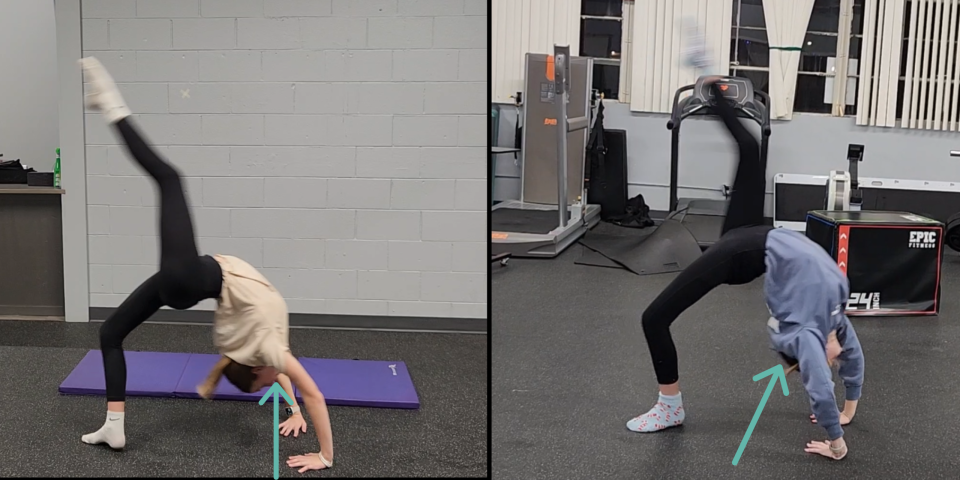
As a physical therapist that has experience in the sport of gymnastics, we have a unique ability to break down common skills or movements from the sport to analyze the biomechanics required. When we break down a skill, there are many things we look for by looking at all joints involved in that movement. When you are experiencing pain with a certain movement or skill, the area we notice that needs to be addressed is very often not the same area that is experiencing pain. In this example, we will be looking at a snapshot of a back walkover when her hands first make contact with the ground, as this is a very common movement pattern in the sport of gymnastics.
Here are some things we look for in a back walkover:
- The distance from hands to feet
- This distance indicates how well you are getting your arms under you. The shorter this distance is, the easier to kick over because you can get your weight through your hands and shoulders to get into that handstand position easier
- Are your elbows straight or bent
- When you bend your elbows, this stops your momentum, therefore, making it harder to get the force you need to kick over. Elbows bending may also be an indication of a lack of mobility or stability at some other area of the body
- Is your top leg straight or bent
- Not only is this for aesthetics and pleasing judges, but it will also help pull you over smoother
- Is your top leg lifting to vertical or lagging behind
- lagging makes it much harder to kick over and increases the likelihood of not making the kickover fully
- Is your chin tucked or is your head looking up
- chin tucked helps pull momentum to get weight over your shoulders and pull you forward through the skill
- What is the angle of your wrists
- Are your wrists bending back excessively to compensate for a lack of shoulder mobility? You ask your wrists to do a lot in gymnastics, and overtime, this could break down your wrists if we are making them bend back further than they need to repetitively
- What is the angle of shoulders
- Are your shoulders reaching back from the start of the back walkover until you reach the ground? Your hands should land in a straight line under your shoulders if you are! With a back walkover, you have to get to that split handstand position as quickly as you can. If your shoulders are not reaching back and you land far away from getting your shoulders over your hands, it will be a lot more effort to get to that handstand position, and it may increase the likelihood of not making that kickover again
- Is your leg lifted before starting the skill
- Not only does this make sure you are leading with your shoulders and upper back to reach backward, but it gets that top leg into a more vertical position when you land, which speeds up your back walkover and makes it smoother
- Are you leading with your arms and upper back, or is the bend initiated with over-arching at your low back
- gymnasts also ask a lot of their low back with frequent arching. Can you minimize excessive arching in your low back by making the whole spine arch equally to prevent low back breakdown? Make sure you reach with your shoulders and upper back first, and your low back will follow and only do as much as it has to at that point. This will also make sure you land with your shoulders over your hands
Takeaways
Overall, there are many factors that contribute to making a back walkover move smoothly. These are some of the points we can look at from a physical therapist standpoint. An issue at just one of these points may be a simple fix, or it may appear as one thing (ex: bent elbows), but it is really a result of a lack of shoulder mobility during this skill, etc. Therefore, saying “straighten your elbows” may not be enough to make a change. This is just one example of an element a skilled PT can break down, but these same steps can be used for whatever skill or element it is you are having trouble with.
About the Author: April Flood