Is Your Kinetic Chain Costing You Power?
June 12, 2025
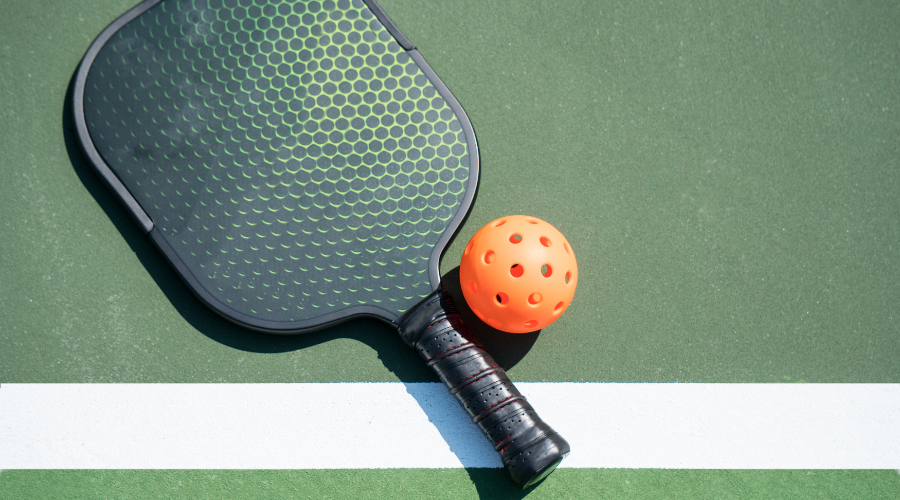
Ever had your tennis or pickleball coach tell you to “use your legs” or “engage your core”? And you’re thinking… What do my legs have to do with hitting a forehand?
Many athletes feel this way, and that confusion is normal. That’s because when we experience pain or injury, especially something like tennis elbow, the focus is usually only on the specific area that hurts. For example, if you go to the doctor for tennis elbow, they’ll probably look at your elbow, recommend ice/brace, maybe an anti-inflammatory, or suggest rest -the worst thing possible as a tennis and pickleball player.
Injuries Don’t Just Happen
There’s almost always a reason behind overuse injuries like tennis elbow. Often, it’s not just the elbow’s fault. You could be gripping your racket too tightly, using strings that are too stiff, strings that have too much tension, or playing with poor biomechanics. But typically, the issue goes deeper — or rather, higher and lower in the body like a kinetic chain! When you have weakness or tightness in other areas — like your wrist or shoulder — your elbow has to absorb more force than it’s built to handle. That’s where the kinetic chain comes in.
What Is the Kinetic Chain?
Think of your body as a connected series of parts — like links in a chain. When you move, especially in sports like tennis or pickleball, power starts from the ground up (your legs) and travels up through your hips, core, shoulders, and forearms/wrists etc. If one part of that chain is weak, tight, or not doing its job, other parts — like your elbow — have to work harder. That’s when injuries happen when it cannot withstand the forces places on it. For instance, a weak wrist or shoulder means your elbow has to compensate. Or if you’re not using your legs to generate power, your upper body ends up doing all the work — and it simply isn’t built for that kind of repetitive strain. No wonder our shoulders and elbows hurt!
The Power Comes from the Ground Up
There’s a reason elite athletes like Federer or Nadal always seem to be moving forward— they are moving into the court, bending their knees, using their whole body to hit the ball. Studies have shown that 55% of power in a tennis stroke comes from the legs, while only 21% comes from the shoulder (Félix et al., 2021). That’s a huge difference! So why are we using just our arms to hit? Why aren’t we using the strongest muscle in your body? The GLUTES! What is stronger your legs or your arms? That seems like a no brainer, your legs! So why not use them when you play? The more you rely on your whole body, the more powerful, efficient, and safe your movements become.
You’re Only as Strong as Your Weakest Link
If any link in the kinetic chain is weak — say your wrist or elbow — the rest of your body has to work harder to make up for it. These muscles fatigue faster and stop doing their original job effectively, which is when injury is most likely to occur. That’s why it’s so important to move as a unit: bend your knees, rotate your hips, engage your core, and let your arm be the final part of a fluid, full-body motion. Not only does this approach reduce injury risk, but it also boosts power and performance — helping you play better and feel better on the court.
About the Author: Denise Smith