Improve Your Golf Game: Addressing S-Posture and C-Posture
July 26, 2024

Golf is a game of precision, skill, and proper technique. One crucial aspect that often gets overlooked is posture at address. Understanding and correcting common postural flaws, such as S-Posture and C-Posture, can significantly improve your golf game and enhance your performance and reduce the risk of injury. Let’s dive into these postural problems and discover ways to address them for a better golf swing.
Understanding S-Posture

S-Posture occurs when a golfer has too much of an arch in their lower back, leading to increased lumbar extension. This excessive arch places undue stress on the lower back muscles and prevents effective use of core muscles during the swing. It’s a common issue for golfers who sit for extended periods, resulting in tight hip flexors and lower back muscles, along with weak or inactive glutes and abdominal muscles. These muscle groups are vital for a powerful and efficient golf swing.
Finding Neutral Position: To correct S-Posture, try this simple exercise:
-
Arch your back.
-
Flatten your back.
-
Arch again and then find the middle position.
This neutral position allows for better engagement of your core muscles and reduces stress on your lower back.
Understanding C-Posture
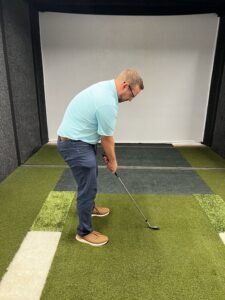
C-Posture is characterized by a rounded or flexed upper back at address, which limits the ability to rotate effectively during the golf swing. When the thoracic spine cannot rotate properly, the body compensates by seeking rotation from the lumbar spine, which isn’t designed for such movements. Over time, this can lead to lower back pain and other related issues.
Improving C-Posture: To address C-Posture, focus on exercises that enhance thoracic spine mobility and strength. A simple exercise to improve your posture at address involves the following steps:
-
Stand tall with your feet shoulder-width apart.
-
Hold a golf club behind your shoulders with both hands.
-
Gently rotate your upper back, maintaining a straight posture.
Incorporating these exercises into your routine can help you achieve a more effective and pain-free golf swing. Remember, good posture not only enhances performance but also prevents injuries, ensuring you can enjoy the game for years to come.
About the Author: Denise Smith