Landing Mechanics After ACL Repair
January 27, 2025

Did you know that one of the most common causes of ACL tears is improper landing mechanics? There are many ways to injure an ACL, often involving contact from another player during a contact sport. However, non-contact related injuries are more common, and can be the result from landing wrong from a jump, pivoting on a planted foot, or quickly changing directions.
We can use many different methods to determine someone’s ability to return to sport safely after an ACL tear and/or repair. Some examples include analyzing landing mechanics, reaction times, strength, stability, hop testing, and agility required for their desired sport. We may also look at these same aspects when determining someone’s risk of injury of an ACL tear.
Analyzing Landing Mechanics After ACL Repair
For this example, we will look at the landing mechanics of a patient that was recovering from an ACL repair. She was far enough out from surgery to start jumping. We will analyze her landing mechanics and point out what we look for as physical therapists.
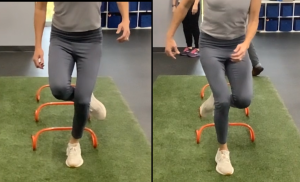
When looking at this picture of a patient landing from a jump on one leg, can you tell which side is her injured side? While she may not have pain and she may feel pretty confident with jumping and landing, there is still an apparent difference from one side to the other that would put her at a greater risk for injury or re-tearing her ACL.
Let’s break this down further and highlight the areas we notice that would indicate this patient is not quite ready for returning to sports.

This is a slightly different image of her right leg, but you can really see the differences here from side to side. Looking at her knees, you can see how her right knee is caving in and rotating in when compared to the left. Moving to her foot, you can also see her right foot caving in, compared to the stacked position on her left side.
This image also highlights the differences in the angle at her knees and trunk:
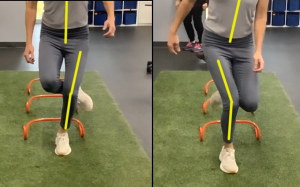
There is greater angle from her knee to her hip when landing on her right side compared to the left. But this image also highlights how her trunk is also leaning more to compensate when landing on her right side compared to her left. This indicates some instability still when landing.
Why This Matters
While she was not necessarily having pain while jumping and she felt confident, we were able to take a closer look at her landing mechanics to point out where the differences existed. From this analysis, we could tell her strength and neuromuscular control was still limited on her right side when compared to her left, uninjured side. Sending her back to sports at this point could result in re-injury as her body is showing she is not quite ready to handle the demands of running, jumping, or changing directions.
This is just one of many components we look at to determine readiness to return to sport. Our goal as physical therapists is to get you back to your sport as quickly as possible, but more importantly making sure you are prepared to go back to your sport safely.
If you are interested in working with a physical therapist to determine your readiness to return to sport, or to schedule an assessment, contact us today.
About the Author: April Flood